Showing posts with label drawstring bag. Show all posts

Wednesday, January 22, 2025

2 More Japanese Rice Bags

I made a couple more Rice Bags to hold sewing machine foot pedals and cords. This has been a useful and fun project to make these bags and I am using up some sewing theme fabrics too. I have been experimenting with the sizes of these bags and tweaking how they are sewn as I try new things with the construction of the bags. 

The bag on the left I quilted with a serpentine stitch and the bag on the right a straight stitch. I used fusible fleece for the bag exterior and fusible interfacing for both linings of the bags to provide a bit of structure. Each bag has a total of 8 total casing tab loops for the drawstring to go through; 2 on each side. The cording was made using a Kumihimo disk and various yarns I already had to create each cording for the bag. Two cords were made for each bag so when you pull the cords, it closes the bag. Kumihimo is a Japanese braiding technique and goes perfectly with these Komebukuro (Japanese Rice Bags), plus I love how the cording looks too!

I cut the 5 exterior squares slightly oversize and then quilt each exterior square, square to size and then assemble into the bag. The bag on the left was squared to 8 1/2" for each square, while the bag on the right was 7 3/4". The bag on the right shrunk up a bit more with the quilting, so I trimmed to the largest size I could after quilting and you can see the bag on the right is slightly smaller.

2 Komebukuro or Japanese Rice bags to hold foot pedals and cords for 2 sewing machines. I made clear vinyl windows to hold a paper saying which machine the foot pedals are for. I can easily change the paper names to hold a different machine or even put a name in the window for using the bag as a project bag by slipping in the project name in the clear window instead. 

drawstrings on bags cinched closed
The Kumihimo cording cinched the bags closed.

looking down into one empty rice bag
This is the slightly smaller bag, but still roomy.

bottom of bag
This bottom I used this fabric as I didn't have enough of the fabric I used for the sides.

looking down into 2nd empty rice bag
Looking into empty bag you can see how roomy it is.


Sewing machine foot pedal and cord in one bag
Sewing machine foot pedal and cord for Kenmore inside bag.

sewing machine foot pedal and cord in 2nd bag
Foot pedal and cord for Pfaff sewing machine inside bag.

After placing the foot pedal into each bag, I saw the Pfaff was a larger foot pedal, so I later switched the foot pedals and machine labels and placed them in the opposite bags, which worked out better.
Pin It Now!

Saturday, December 28, 2024

Japanese Rice Bag (large size)

I have been making some Japanese Rice Bags for holding my various sewing machine foot pedals and cords, etc. That way those items stay together when I switch machines, which I do from time to time. I needed an extra large bag to hold the large foot pedal for my Elnita machine. It came with a small foot pedal, but that foot pedal that came with the machine seemed too tall and it was hard to sew for long. This extra wide and lower foot pedal cost extra to buy, but was worth it as I can sew more comfortably using it. 

I don't understand why some sewing machine brands nickel and dime you on certain items instead of just including them with the machine in the first place. This machine is a made with the quilter in mind, yet it only came with free motion quilting feet (3 different ones) and no walking foot. I had to buy the larger foot pedal, a knee lift, a walking foot, a button sewing foot, an open toe foot for appliqué. It did come with an appliqué foot, but it has a bar across it, which makes seeing more difficult when doing appliqué. (Who designs these machines? Certainly not someone who appliqués)! So while the machine itself cost less than other machines that came with all those things and more, the price was still a lot less than the machines with more bells and whistles that I wouldn't use. I suppose by not including those extras, it appears to be an even better deal at first look? Sorry, I got carried away. On to the bag!

I quilted the bag with narrow vertical quilting lines. I made 2 Kumihimo cords for the drawstrings. Kumihimo is a Japanese braiding technique and I thought it not only looked good with these rice bags, but I got to use up some ribbon and other miscellaneous yarn I had on hand in the process of making the cords too. Yay!

looking down into empty bag
Sure looks like a deep bag looking down into it empty.

looking down into bag with sewing machine pedal and cord
Inside the bag I placed the foot pedal, cord, knee lift and plastic stitch chart that fits onto the machine showing what number and mode to select for each stitch. I cut a pool noodle to slip over the end of the knee lift so that it is more comfortable to use. Don't you love all the stuff you can do with a cheap pool noodle? I do, and I don't even have a pool! 😄

looking down into bag with sewing machine pedal
In the photo above, you couldn't see the extra large foot pedal, so here it is. Now you can see why I needed a large bag to fit it.

bag with drawstring closed
Drawstring here is cinched closed.

front view
I added a clear vinyl window and inserted the name of my sewing machine in the window. I could insert a different machine name in the window if I ever wanted to use this bag with a different sewing machine.

bottom of the bag
Here is the pretty bag bottom. I only had enough of the exterior fabric to cut 4 squares, but 5 squares are needed to make a rice bag for the exterior and 5 for the interior lining too. So, since the bottom is rarely seen, I chose to use this print for the bottom, which really is perfect as if you look closely at the cute exterior print of the bias tape packages, one of them has a red check just like this. I also repeated this print by using it for the drawstring tabs.

You can make each of the 4 sides of the bag in different fabrics, or make each side artsy using hand or machine stitches, appliqué, patchwork, etc. I have seen lots of great looking rice bags out there online. But for my purposes, I didn't need anything fancy to hold my sewing machine pedal and cord.

I still have a few more of these rice bags to make for some of my other machines too. I have mostly vintage machines and I wanted a bag for each of them too. I just need to cut out the material and quilt them. I have been using my sewing theme fabrics for these bags, if you have been following my other post I shared for 2 rice bags I had shared a while back. 

Happy Sewing in the New Year!!!

Pin It Now!

Sunday, November 24, 2024

Japanese Rice Bags to Hold Sewing Machine Foot Pedals & Cords

I have a few sewing machines, mostly vintage machines and I needed some bags to hold the foot pedal and cord in so the pedals don't get lost or misplaced. I made a clear vinyl window for each bag and printed out the name of the machine to slip into the clear pocket so that I make sure that I have the correct pedal and cord for each machine to make it easier to find. 

The style of these bags are called Komebukuro or Japanese Rice Bag. Since this was a Japanese design bag, I decided to make my own drawstring cording using another Japanese technique called, Kumihimo, which is a braiding/cording technique done on a foam disk or traditionally with tools like the marudai & takadai that were developed to create intricate braids with greater efficiency. Marudai tool makes round braid, whereas the takadai tool makes a flat braid. You can go to this site to see some photos of the various tools, including the simple portable ones they have today, which is what I use.
Kumihimo are braided silk cords that have been made in Japan for over fourteen hundred years! 

I made Kumihimo cording for my Rice Bags by using up what I already had on hand. I am trying my best to not buy anything and to use what is available in my supplies. I used ribbon yarn in a variegated black/gray color along with a green yarn. I ran out of the one green yarn and grabbed another green yarn that was close. So the bag that holds the Brother pedal has one different green in one of the cords I was making, while the Pfaff cording was all the same green. 

These were quick to make once the quilting was done. The quilting took the most time, but you don't have to quilt the bags or quilt them so close like I did. I cut my fabric and batting oversized when I quilt as the fabric/batting squares do shrink up quite a bit. The 5 squares were squared up after quilting to 7.5" square and another 5 squares were cut for the lining, along with interfacing for the lining as well. 

Some people get artsy with each square side of their bags and do hand stitching, appliqué, piecing, embroidery, etc. You can certainly make a very unique bag by making each of the 4 side different. I didn't need such a fancy bag to hold my machine pedals in, so this was a quicker bag to make for that purpose.

My bags are happy holding the pedals and cords for my sewing machines. I recently made a large one for a newer machine that has a much larger foot pedal. I will share that one soon.

I made a clear vinyl window for each bag so I could slip in the name of the sewing machine. 

Looking down into bag holding foot pedal and cord
Inside each bag is my foot pedal, cord, and for the Brother machine on the left is my clip on stitch chart too.

Pin It Now!

Saturday, October 5, 2024

Adorable Size Round Japanese Rice Bag (Free Pattern & YouTube Tutorial by Liz)

Last month I made a traditional square Japanese Rice bag that I shared here. Shortly after I made it, Liz (of Moments by Liz), came out with a round Rice Bag in 4 sizes. She named the sizes: Too Cute, Adorable, Just Right & Kitchen Sink. The round bottom templates are free and the Video YouTube tutorial is free too (scroll down to very end for link). When you click on Liz's YouTube at the end of this post, you will find the link to her free pattern for the round bottoms and the rest is cut from measurements using a ruler and rotary cutter. 

Here is my Adorable size round rice bag. It is a pretty cute size, but Too Cute is even smaller. Also, Liz has measurements for making the accent base or using just one fabric, so they are both in her pdf. And, she shows you how to make the tulips ends to cover the knots in the cording if you want to do that. I did not do that with mine though.

The traditional square Rice Bag I made recently, I chose some sewing theme fabric in a different print and color. So I decided to stay with the sewing theme and chose this print for the round bag. I quilted the exterior and the bottom of the bag.

looking down into the bag
The lining fabric is also  sewing theme print with scissors, needle and thread.

Here she is with the drawstrings closed. I again made my drawstrings in Kumihimo (Japanese braiding) for this bag as I did for the square rice bag.

drawstrings closed
This time I made the tabs for the drawstring out of the same cotton pink fabric as the accent and bottom
 of the bag.

quilted bottom of bag
Quilted bottom of the bag.

drawstrings closed view from top of bag
Closed view from above.

vinyl cord stops I made
I made my cord stops out of vinyl. You can buy plastic cord stops or use beads, but both of those need to have large enough openings to fit the cording. Or you could knot the 2 cords together if your cords are long enough to do that. I chose to use wrap my cords together with an elastic hair tie.

Have you ever made a square or a round Rice Bag? Do you have a preference as to round or square? I think I am more partial to the square traditional rice bags, but the round ones are fun too. I suppose it depends on what you will put inside the bag that really matters and the size of bag that you need for your item(s) that you are carrying. I doubt anyone is carrying rice anymore, but you never know. I think I will make some more square rice bags to put my machine pedal and cords in. I will make a name for each bag too so I know which pedal and cord goes to which machine. Now to decide on the right size bag to make. I need one a bit smaller than the last square rice bag I made. 

Happy Rice Bag Making!


Free YouTube tutorial from Moments by Liz~

Pin It Now!

Thursday, September 19, 2024

Japanese Rice Bag ( Komebukuro) with Kumihimo Cording

I wanted to make another Komebukuro, or Japanese Rice Bag, but try making a larger size this time. I had enough of both the outer fabric and the lining fabric to make the sides of the bag, so I chose another fabric for the bag bottom. You can use all one fabric for the outer (or lining), or each side could be a different fabric or a different quilt block or embroidery or appliqué. I might try making another bag using appliqué or pieced blocks for each side. That might be a fun way to make this bag unique and use up scraps and try new quilt blocks too.

You can make this bag in any size that you want. The exterior is made up of 5 square blocks and so is the lining. So choose what size you want to cut or what fabric that you have enough of that you can cut 5 squares (or 4 as I did with a different bottom). You don't want to go too small or too large, so I would say 6" cut squares as the smallest up to 10" squares as the largest size. I suppose you could go larger, but it might result in a more floppy bag if you go too large? Adding interfacing or stabilizer might make it harder to close the drawstring? I am not positive, so experiment with size and materials to see what you prefer.

My bag was cut with 9" squares and is a nice size. I used 1/4" seam allowance. The lining I quilted to batting using a walking foot in straight lines. I did add a woven fusible interfacing to the exterior fabric pieces too, so it wouldn't be too floppy. It stands up nicely and is not too floppy or too rigid, so I like this combination of this structure. 

I made the drawstring cording with another Japanese method, called Kumihimo, which is a braided cord using a round disk and string or yarn. I used 4 different colors and 2 types of ribbon yarn that I had already. I used vinyl pieces for the little loops that the cording passes through for the drawstring.

This Sewing Theme fabric is fun as each side looks a little different.

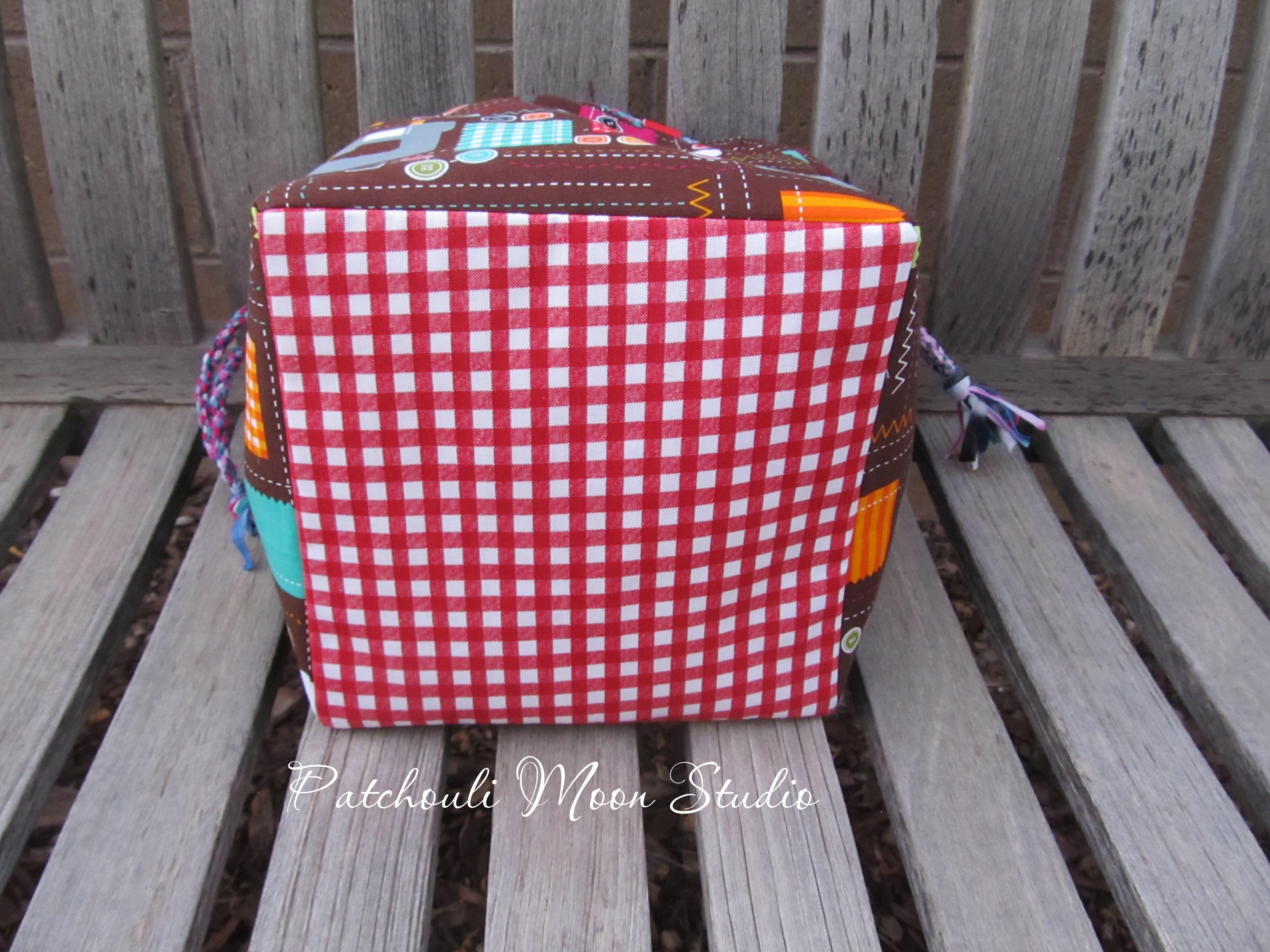
bag bottom
I used this red and white check fabric for the exterior bottom.

Inside bag
Another Sewing Theme print for the lining. This print was depicting cards of buttons and snaps from long ago. I quilted the lining in straight lines.

drawstring closed on bag
Here is the bag closed with the drawstrings

Inside bag
Another lining view.

Inside bag
View inside the bag from the top. Pretty roomy bag.

Top view of bag drawstring closed
Top view of bag drawstring closed.

Another side of bag
Another side of the exterior.


Pin It Now!

Thursday, June 9, 2022

Stand & Store Baskets

Hello Basket lovers. The Stand & Store Baskets from Around the Bobbin are so practical, easy to sew, have a drawstring, a cuff, come in 4 sizes (Itty Bitty, Small, Medium & Large) and are so darn cute too! Why not make a few for yourself? The pattern is on SALE right now too! Coupon code SAS15 for 15% off the pattern, good through Sunday June 12 CDT.

You can use these baskets to hold almost anything. The Itty Bitty is great for holding your sewing clips, and the large and extra large make a nice project bag for knitting, crochet or hand embroidery and more. The small and medium sizes will hold so many other things too, so pick the size you need and sew one up.

I tested the Medium & Large sizes:
Medium & Extra with their cuffs folded down.

View of the inside of the large bag. There are mesh divided pockets to hold even more stuff.

This is the inside of the medium bag. Same as the large, except a bit smaller. The only sized that doesn't have the mesh pockets is the Itty Bitty as it's just too itty bitty, lol!

I put up the cuff on the large size and pulled the drawstring closed so you can see and compare how it looks and functions compared to the medium size that still has it's cuff folded down.

Here both bags have drawstrings closed. This makes it great for transporting your basket that might be filled with stuff so the contents stay inside as you carry it elsewhere. Then when you need to access the contents, fold the cuff back down.

You can even nest the 4 sizes inside one another, if you make all 4 sizes. Great way to store the baskets when not in use.

The large is a great knitting project bag. My knit socks are in progress. I pulled the items up to the top to photograph.

Here the items are down inside the bag and you can see there is plenty of room for my knit project and pockets to hold my counter and more.

These baskets are so handy and useful and would make a great gift or even a great gift wrapping! Get the pattern while it's still on sale. And check out the tester's versions too here.


Pin It Now!

Tuesday, March 15, 2022

Alice Bucket Bag by All Sew Petite

Hello my lovelies. This is the Alice Bucket Bag I tested for All Sew Petite recently. The pdf includes 2 versions: the Drawstring Cross Body Alice & the Backpack version with a flap. I chose to make the cross body version. To see all the tester's versions of the cross body or backpack versions go here.

For the cross body version, the bag features a drawstring closure and grommets for the drawstrings, a 3 dimensional outer zipper pocket that has card slot pockets inside, an adjustable strap, and full wrap around divided slip pockets inside to hold all kinds of things.

I decided to make this bag using a thin vinyl exterior (the floral print). I used cotton gingham for the accent, but first I painted on some Liquid Vinyl to make it like vinyl too. I used 2 coats of Liquid Vinyl. It's a great product from Therm-o-web. Read all about it here. Cotton fabric was used for the lining.

I enjoyed making this bag, but I had a brain fart moment! I somehow placed my exterior pocket on high, instead of low, on the bag! You will see the difference when you look at the other tester's bags. So I am calling it a design decision instead of a goof, lol! It does make it easier to zip and unzip and access the pocket being higher though, lol! The instructions are excellent as always with Monika's patterns & the video makes it even easier, especially if you are in question about something. If only there was a video when I was sewing that pocket! LOL!!! 

Alice Bucket Bag measures: 25 cm / 21 cm / 14 cm (9 7/8”H / 8 1/4”W / 5 1/2”D).

Skill level: Intermediate


So here is my pretty Alice:

I placed the zippered pocket up higher on the bag than it was supposed to be. Design feature? LOL!

On the cotton gingham fabric I used Liquid Vinyl on it so it feels like vinyl like the rest of the bag. It will keep it clean and waterproof too. 

I made a beaded zipper pull with a bag charm.

The grommets and drawstring closure.

Inside the outside zipper pocket are 3 credit card pockets. I chose to add this part against the outside of the bag so when it is unzipped the cards will face the wearer and it will be easier to access and see the cards. The directions have you place the card pockets against the bag, but you can certainly sew it how you like it like I did.

This bag opens nice and wide and will hold a lot in the main part of the bag. There are pockets that wrap around the sides and front and are divided as you like them (I divided into 3 pockets. There is also a key leash that you can clip to your keys and make it easy to find them later.


Side view.

The bottom view. You could add purse/bag feet if you like, but since is a cross body bag that will be hung up and it is vinyl, I decided to not add the feet.

There you have it. Monika of Sew All Petite has a YouTube channel of her patterns too, as well as some free patterns, so check out her channel and follow along on her video if you purchase Alice or any of her other pdf patterns.

Alice Bucket Bag pdf is on sale for 48 hours (UK time), so if you want to save a bit of money, grab this pdf while it's on sale. No code needed. Shop All Sew Petite here.


Pin It Now!
Related Posts Plugin for WordPress, Blogger...